

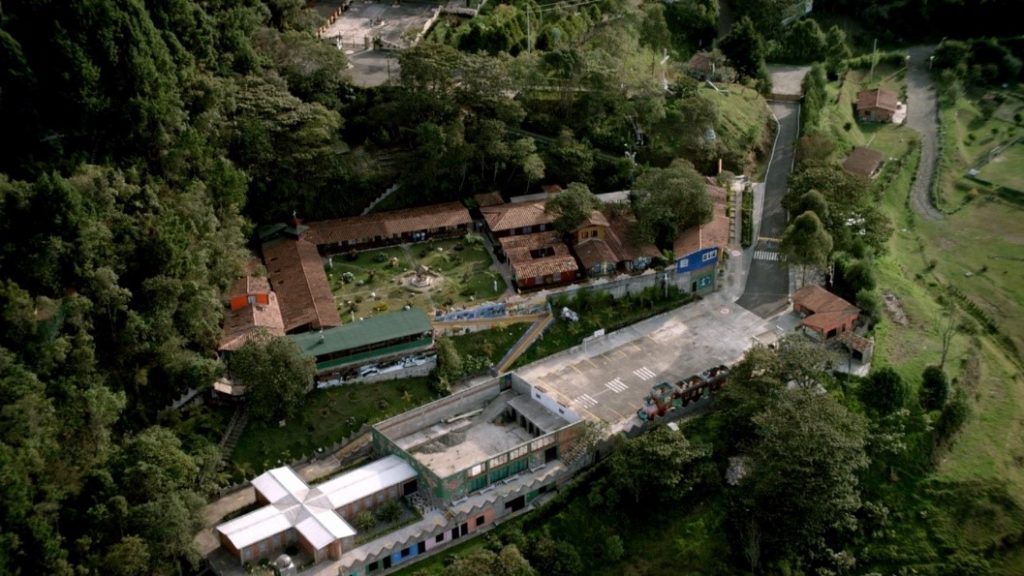
Carlos Holguin Police School – Medellin, Columbia
When I got to Medellin, it was under siege. A siege perpetrated by a segment of its own citizens. It was literally a self-inflicted wound. Pablo targeted the disenfranchised sector of Medellin’s populace by building low-cost apartments for the homeless and handed out food and money. In short, he bought them at a price that to him had to be insignificant for what he got in return.
His self-serving generosity bought for him an ever-watchful security network that would tip him off to the presence of anybody or anything that seemed out of place, namely the police. It also gave him an endless supply of sicarios, assassins that worked on the cheap getting paid as little as $65 dollars US to murder a cop. I recall a Catholic priest, who he duped into believing that he was a God-send, calling his ‘unjust persecution’ a product of American imperialist ‘monkeys’ wanting to perpetuate their stranglehold on the poor of South America. I like to think I’m a good Catholic, but I must admit that nothing would have given me more satisfaction than to slap that empty-headed moron, who willfully turned a blind eye to the evil perpetrated by a truly evil man.
To protect themselves, the rank and file policemen assigned to Medellin ignored their duty and many went as far as to collaborate with Pablo’s minions. Corruption is not always driven by avarice. In Colombia, it was driven by self-preservation. How can you fault someone for wanting to protect themselves and their families from being obliterated? It’s easy to sit back and judge them for being corrupt from the comfort of one’s home.
The members of the Cuerpo Élite, the core of the Search Bloc, were marked men. To defend themselves, they commandeered the Carlos Holguin police academy and cordoned off the neighborhood surrounding the school. Barricades were set up. Fifty-five-gallon drums filled with concrete were placed on the approaches to deter suicide bombers from driving car bombs into the school. (There was no lack of young men living in Pablo’s housing projects that would gladly commit such a sacrifice for Don Pablo on the promise that his family would be cared for). Routine patrols kept a watchful eye on the perimeter and heavily armed guards manned the entrances. Still, they were never truly secure.
They were always being tested by infiltrators and well-placed informers. The guards watching the entrances, boys really, were lured away from their posts by attractive young ladies of which Medellin had an infinite supply and horribly murdered. Their bodies were displayed as a warning to the members of the Cuerpo Élite. They were unloved, unappreciated, and unwanted by the very people they were there to save from a self-serving bastard they thought was their benefactor.
Javier Peña was well entrenched with the Search Bloc, having worked with them since his arrival in Colombia and their creation by President Barco in 1989. He made regular trips to Medellin to coordinate with their efforts until Pablo’s so-called surrender in 1991. With Pablo’s surrender, many of the key players including their stalwart commander, Colonel Hugo Martínez were reassigned, weakening the effectiveness of the Elite Corps.
The first order of business for me was getting into La Catedral and tracing the non-government issued guns used by Pablo’s handpicked guards to resist the Colombian hostage rescue team. As you might have gathered by now, things work a little different in Colombia. The police now had control of the prison after Pablo’s escape, but the army controlled the access. The Colombian judges with jurisdiction wanted to control every aspect of the investigation, leaving no room to gather intelligence. A scheme was worked out to send me into the prison dressed as a Colombian policeman. The plan, though a good one, fell short because we couldn’t find a uniform big enough to fit my six-foot-one frame.
The CIA and the Seventh Group Special Forces officer assigned to train and develop the Urbana (the hostage rescue team) were interested in their protégé’s performance and they asked me to take pictures of the entry points, looking for evidence of the techniques they were trained to use. The agency was also interested in getting as many pictures as possible of the prison, living conditions, amenities, and what not. They provided me with a digital camera that at the time was cutting edge technology.
I finally got my chance to get in when the judges asked the FBI at the Embassy to help them process forensic evidence relating to the murders of Galeano and Moncada. So, I flew to the jail with the two FBI agents in a Colombian Bell 212 helicopter (the kind used in Viet Nam), posing as a seismograph engineer sent there to look for tunnels rumored to be under the grounds under the property. I collected the gun information, took the pictures relating to the taking down of Pablo’s personal guard, and pictures of the prisons lavish accommodations, disco tech, and soccer field. I also took pictures of a ramp leading from the jail, up a slope into the woods behind the prison. What I found astounded me. Pablo had a system of interconnected tree houses, some built as bunkers, others used by Pablo and his fellow ‘inmates’ to have sex with the prostitutes and beauty queens brought to the prion for them.
I sent the camera back to the Embassy with the FBI guys and returned to the Carlos Holguin school. The pictures I took were the first taken, providing evidence of the lavish accommodations of Pablo’s self-made prison. The pictures were used to show the world.
At the time all this was happening, the Search Bloc was headed by a Colonel Pinzón. I think his first name was Armando, but it might as well have been Armand. The man was a dandy. He focused far too much attention to his appearance and it was not uncommon to see him getting a pedicure in the afternoon in the adjacent room next to where I was quartered. That did little to bolster confidence in the men working under him.
The military communications experts started arriving at the school shortly after Javier and I did. They were placed in a classroom adjacent to the officer’s quarters and the administration building where Pinzón ran the Search Bloc. They were all somewhat younger than Javier and me, whose age was more consistent with the Elite Corps commanders. Among them were members of Delta Force and SEAL Team 6. They set up shop and went to work immediately intercepting signal intelligence from Pablo, his lieutenants, and their military wing. The cartel knew that the police had tapped their landlines and cellphone technology was still in its infancy. Pablo and his people communicated using radio telephones, making it easy for the team to intercept their calls using a technology dating back to the Second World War.
They conveyed their leads to Pinzón, who either ignored them or was reluctant to act for whatever reason. I don’t believe he had been corrupted by Escobar, but do believe he resented the American presence. He practically ignored me any time I tried to report to him anything I thought he should know.
His reluctance to act infuriated the Delta Force officer in charge, who I believe by his age couldn’t have been more senior than a captain, but who represented himself to be a full bird colonel. I could see in the eyes of our Colombian counterparts that they had trouble accepting that he was a colonel. Javier and I tried to point out the reality of working in Colombia to the Delta Force officer, who wanted to withhold U.S.-bought fuel for the CNP’s helicopters if Pinzón did not man up and act on the intelligence his team handed him.
As far as rank is concerned, neither Javier nor myself purported ourselves to be anything more than federal agents sent there to help. They, being a paramilitary force, felt it necessary to address us by some sort of rank other than señor, so they gave us the honorary rank of major, consistent with the top rank next to the colonel in charge. It was quite an honor.
Javier and I conferred with our U.S. colleagues to smooth the rub between their get-it-done mentality and the Colombian mindset. They were far more familiar with the reality of hunting Escobar in an environment friendly to him or terrified by his legion of cutthroats. Our U.S. colleagues were unfamiliar with the rules of engagement forced upon the Cuero Élite. Pablo had it arranged that he could move at a moment’s notice through a prearranged escape route. Because of the Robin Hood image among the common folk, there was no way that the police could come anywhere near where he was hiding without Pablo being tipped off long in advance. The Elite Corps moved like a military column and could be spotted coming miles away, giving Pablo more than sufficient time to make his escape.
On the other hand, even if our guys had come up with a magic bullet to finally take out Escobar, Pinzón would have ignored it or been slow to act. So, life went on. Javier and I doing our thing, the Delta and SEALs doing theirs, and Pinzón getting his pedicures. It was like watching Nero play the fiddle while Rome burned.
I fell into a ho-hum routine, still getting out of bed between three and four in the morning to start my day, however fruitless it would turn out. You might think that being housed in the officer’s quarters entitled me to special privileges not enjoyed by the enlisted ranks including a basic amenity like hot water – but it didn’t. Medellin is known as the City of the Eternal Spring with an average temperature during the day in the low seventies and the mid to upper fifties at night all year round. The city is located high in the Andes and because of its elevation and proximity to the equator, the temperature never varies except during the rainy season when it is much cooler. If not for the lack of hot water, it would have been the ideal climate. Because of the time I spent at the school, I developed a fondness for cold showers. At the time, though – it was not fun.
The same can be said for the meals we ate at the casino, what they called the officer’s mess. Breakfast consisted of a cup of white rice, a cup of powdered eggs, a French roll, and a cup of chocolate. I could handle that. However, lunch fell far short to satisfy the appetites of two hungry Texans.
Lunch consisted of a humble salad consisting of a leaf of lettuce, a thin slice of tomato, and two strands of onion. The main course consisted of a sliver of meat that resembled a shoe tongue in size and thickness. It was accompanied by a bowl of chicken consume with either a chicken neck or chicken foot in it we called chicken-dick soup. Supper was the same, except that you didn’t get the soup. The casino had jars of unrefrigerated mayonnaise sitting on the tables the Colombians used to dab on the meat before eating it. I found that it helped.
I spent my days finding things to do, although back in Bogota I had plenty to do waiting for me. I read novels by John MacDonald, Clive Cussler, Joseph Wambaugh, and Elmore Leonard. I conducted impromptu lectures regarding weapons identification, and hung out with Javier, the Delta guys, and the SEALS in their classroom.
We were all chomping at the bit for something to happen. Then, Colonel Hugo Martínez showed up and we were off to the races.
