


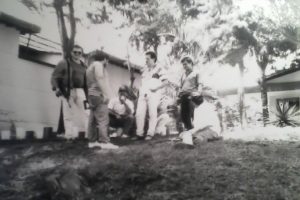
With Search Bloc cover team at Carlos Holguin base
Almost as soon as Colonel Hugo Martínez’ arrived, the atmosphere at the school changed. He took immediate steps to get the Search Bloc out of the bull pen and into the game. He welcomed the Americans sent to the Carlos Holguin school and readily incorporated us into the operation. An important part of that operation included the use of informants (Human Intel). Some had already been documented by the national police or the DEA and were already hard at work. Others were cartel associates captured by the Search Bloc, who turned on their associates. Then, there were those developed through the Pablo Hot Line.
I’m not certain when exactly the Pablo Hot Line was set up, and only became aware of it when Colonel Martínez took charge leading me to believe that if he didn’t initiate it, he at least enhanced it. A bank of phones was set up to take in tips from the public regarding the whereabouts of Escobar and/or his henchmen in a classroom adjacent to where the American military communications specialists conducted their listening operations. The lines were manned by national policeman, who assessed the call and passed it on to their superiors if deemed viable. The biggest problem was that Pablo’s misguided following in Medellin swamped the lines with crank calls making it all but impossible for a serious caller to get through, hampering the effectiveness of the hot line.
When a viable informer did get through, it was necessary to assess whether the caller was genuine or part of a scheme to lure the police into a trap. If it was determined that a caller might be sincere, the next step was to bring in the prospective informer. Prospects were reluctant to come to the police school for fear of being seen by a cartel spy. It was a reasonable concern. So, it was necessary to send a team of national policemen led by an officer to bring in the prospect. As you can imagine, the proposition was extremely dangerous. It was next to impossible to be certain that they weren’t heading into a trap.
Often, the caller refused to talk to anyone but an American. This put Javier and I in a peculiar situation. We were the only Americans authorized by the ambassador to set foot outside of the base. The cartel knew Americans were in Medellin working with the Search Bloc and nothing would have served their purposes more than for one of us to be killed. It could turn American popular opinion against the U.S. involvement in the hunt for Escobar and give rise to congressional inquiries that could potentially result in a pull back of the U.S. commitment.
Javier and I spoke personally with the prospects over the phone and did our best to persuade them to meet first with an officer of the national police. However, sometimes the prospect refused, expressing their fear of Escobar’s reach into the national police. It was either meet with an American or nothing at all. The choice was a no-brainer – we refused to meet them. However, on occasion a caller, who would only agree to meet with an American, would relate significant information that couldn’t be ignored. Sometimes, you just had to take a chance.
The Colombians realized we were high value targets and took precautions any time we left the school to bring in a prospective informant. A plainclothes team was assigned to take me (or Javier) where we needed to go to cover our movements. The meetings always took place in public areas that were easy to watch. The national police sent in scouts to reconnoiter the meeting place to look for threats and positioned their operatives strategically to cover the meeting. We avoided setting patterns and seldom used the same place twice.
A good example of the types of places we used was the bus terminal. It was a big place designed much like a shopping mall. It had shops and mom and pop eateries along the sides of a wide promenade on the first floor. It had a second floor from where you could look down on the first floor from a long balcony that ran on either side. There was an array of payphones sitting side-by-side around a massive column located at one end of the first floor that could be easily watched by the cover team.
I would tell the prospect where we were to meet at the last possible moment giving him very little time to get there. Doing this made it difficult for a hit team to set up and afforded the cover team the opportunity to watch for it. The description I gave of myself to the prospect was completely opposite of my true appearance. Only the shirt I was wearing was accurate.
When I spotted the prospect standing by the payphones like I directed him to do, I walked up to a nearby phone and started talking to him. I have a very distinctive voice and the prospect immediately grasped who I was. I escorted him to a café across from the payphones and sat him down to talk. The Colombian major heading the cover team sat at a table nearby waiting for me to signal him to join us. I emphasized to the prospect the necessity of working with the national police, reassuring him that he would be safe working with them. At that point, I turned him over to the Colombian major and we went back to the school to debrief the prospect.
The information gleaned from the debriefing of established informants, cooperating defendants, and informants developed through the tip line included the locations of safe houses where the cartel members hid. Sicarios, midlevel traffickers, money launderers, girlfriends, you name it were also identified. The informants also identified the locations of stash houses containing cocaine, precursor chemicals, money, computers, guns, ammunition, and explosives.
At night, we would take informers out to point out these locations. I would ride along with the informant and the major while the cover team rode in other cars. We drove all over the city into neighborhoods entirely populated with Escobar’s sympathizers. Sometimes, it looked like the bystanders paid a little too much attention to our cars when we drove by them. We constantly had to watch for counter-surveillance. We were always on our guard, watching traffic for anyone that might decide to follow us. The cartel’s sicarios were skilled at setting up rolling ambushes and we also watched for that.
After we returned to the school, we gathered with the uniformed unit commanders to point out the targets identified in our intelligence gathering foray. The unit commanders took the information to the colonel. Plans were hatched out and assignments were made.
At dawn, the morning after, the Elite Corps loaded their troops on military-style transport trucks and went out to raid the stash and safe houses. The plainclothes teams also went out, presumably to capture the cartel members they could. Oftentimes, they were met with armed resistance resulting in the demise of the people they went out to capture.
Javier and I would wait for the Elite Corps to return to the school with the fruit of their raids. It kind of reminded me of those old bomber movies where the staff at an airbase waited for the bombers to return. The trucks rolled through the gates one-by-one around three o’clock in the afternoon. That’s when we went to work.
I went to work identifying and collecting tracing data off the guns, ordnance, and explosives they brought in while Javier handled anything drug trafficking-related including identifying anyone brought in alive or otherwise. It was really quite gratifying being able to help the cause.
Javier and I also went out with the Elite Corps and the plainclothes teams on information developed by the U.S. military communications specialists through signal intercepts. I will touch on this in the next segment.
